Why We Never Pay Interest on Travel (And How We Fund Every Trip in Full)
July 25, 2026 · 2,531 days to go
There is one rule in our house when it comes to travel. We do not finance it. Ever. No credit card balance carried forward, no “we’ll pay it off next month.” If we haven’t saved for it, we don’t go.
That rule did not come from a personal finance book. It came from something a lot harder than that. And it is the single most important financial habit we have built on the road to a debt-free travel retirement.
Here is where it came from, how it works in practice, and what it actually feels like to live by it.
It Started With Losing Everything
In 2009, Jeff and I had a mortgage, a second mortgage, and a collection of things we had financed that we probably should not have. When the housing crisis hit, we lost it all. The house. The cars. We were starting over from zero.
I am not sharing that to be dramatic. I am sharing it because that experience is the foundation of every financial decision we have made since. What came out of it was a completely rebuilt relationship with debt: you only take it when it is truly necessary. And a vacation, something meant to bring you joy, is never necessary. It is a choice. And if you cannot fund the choice, you do not make it yet.
It’s about understanding what debt is and having lived the consequences of impulsivity.
This is not a travel rule. It is a life rule that travel falls under. The distinction matters because a lot of people finance vacations without connecting it to a larger pattern. We know exactly what that pattern costs. We lived it.
Jeff and I are fully aligned on this. It is not my rule that he tolerates. We built it together out of something we went through together.
How We Actually Fund a Trip
People ask us this a lot: how do you actually do it? How do you save for a trip without putting it on a card?
The answer is a spreadsheet and a timeline. Every single time.
Step 1: Name every cost
Before we commit to any trip, every line item goes into a spreadsheet. Flights. Hotels. Cruise fare if it’s a cruise. Excursions. Tours. Incidentals. Everything gets named and priced. No guessing, no rough estimates. Real numbers.

That total tells us whether the trip is actually doable — or whether we need more time or a scaled-back vision. You cannot make a real decision without a real number.
Step 2: Work backwards
Once we know the total, we work backwards from the trip date. How many months do we have? How much do we need to set aside each month to arrive at the full amount, debt-free, before we leave?
If the math does not work in the timeline we are thinking, the trip moves. Not the rule.
The spreadsheet is not busywork. It is the decision.

Step 3: Build in breathing room
We always set aside a little extra beyond the planned total. Not a lot. Just enough for something unexpected — a spontaneous experience, a missed connection, a meal that was not in the budget but was worth every penny. Planning for the unplanned is part of the system.
I will tell you exactly why that matters in a minute.
↓ Want the exact spreadsheet we use? Download the free Trip Cost Tracker below. ↓
LINK: Trip Cost Tracker download
When “Afford” Meant Something Different
Here is something I want to be honest about: even after we rebuilt, even after we paid off more than a hundred thousand dollars in student loan debt using the debt snowball method, we still made impulse purchases. We still carried occasional debt we did not need. Because we always thought, there is time. We will pay it off. And we did. But not without paying interest along the way.
What changed was retirement getting real. When you are looking at a fixed income, when there is no “we will make more next month”, the math looks completely different. Every dollar spent on interest is a dollar that does not fund the life you worked decades to build.
Our definition of ‘afford’ is what truly changed. And that drives everything today.
Affording something used to mean: we can make the payments. Now it means: we have the money, it is ours, and spending it costs us nothing beyond the price.
That shift is what makes the plan work.
The Emotional Weight of Paying for Old Moments
For a long time, I was the one in our household who did the bills and managed the budget. Jeff knew the general picture. I felt every payment.
There is a specific kind of weight that comes from paying for something you already experienced. You are trying to live your life right now, making plans, enjoying the present, and there is this old thing sitting on top of it. A trip from eight months ago. A purchase from last year. You are still paying for it while life keeps moving.
It stops you from enjoying the current moments because you are still paying for old ones.
That feeling is why the rule exists. Not theory. Not discipline for its own sake. The actual, lived experience of being financially behind on something that was supposed to bring you joy.
No trip is worth that. Not one.
Earned vs. Entitled: The Distinction That Changes Everything
If you are someone who puts travel on a credit card and tells yourself you’ve earned it, I want to offer you one reframe. Not to shame you. Because I understand the feeling completely.
When you think about a vacation, you think: I earned this. I work hard. I deserve a break. And that part is true, you did earn the time off. But earning the time and earning the money to pay for the trip are two different things. If you are putting it on credit, you have not earned the trip yet. You are borrowing from future you to give present you something present you has not yet built.
The key word is earned. If you have to pay for something with credit, you have not earned it yet.
In retirement, this distinction becomes everything. Because your income is fixed. What you have is what you built. There is no entitlement, not to a trip, not to a lifestyle. There is only what you actually saved, planned, and earned.
The good news: earning it is completely within reach. It just requires deciding that the plan matters more than the impulse.
What Debt-Free Travel Actually Feels Like: The Greenland Story

Last summer Jeff and I were on a cruise, the entire trip paid for before we ever stepped on the ship. We were working our way around the British Isles on our way to Greenland when an excursion came available. A small group trip to a remote hot spring. Very off the beaten path. The kind of thing you do not plan for because you do not know it exists until you are already there.
Jeff and I looked at each other. Obviously we were doing this. The cost was a thousand dollars a person.
We said yes without a single second of guilt. Without one conversation about whether we could afford it. Without any shadow of a bill coming later. Because we could. We had built in room for exactly this kind of moment.
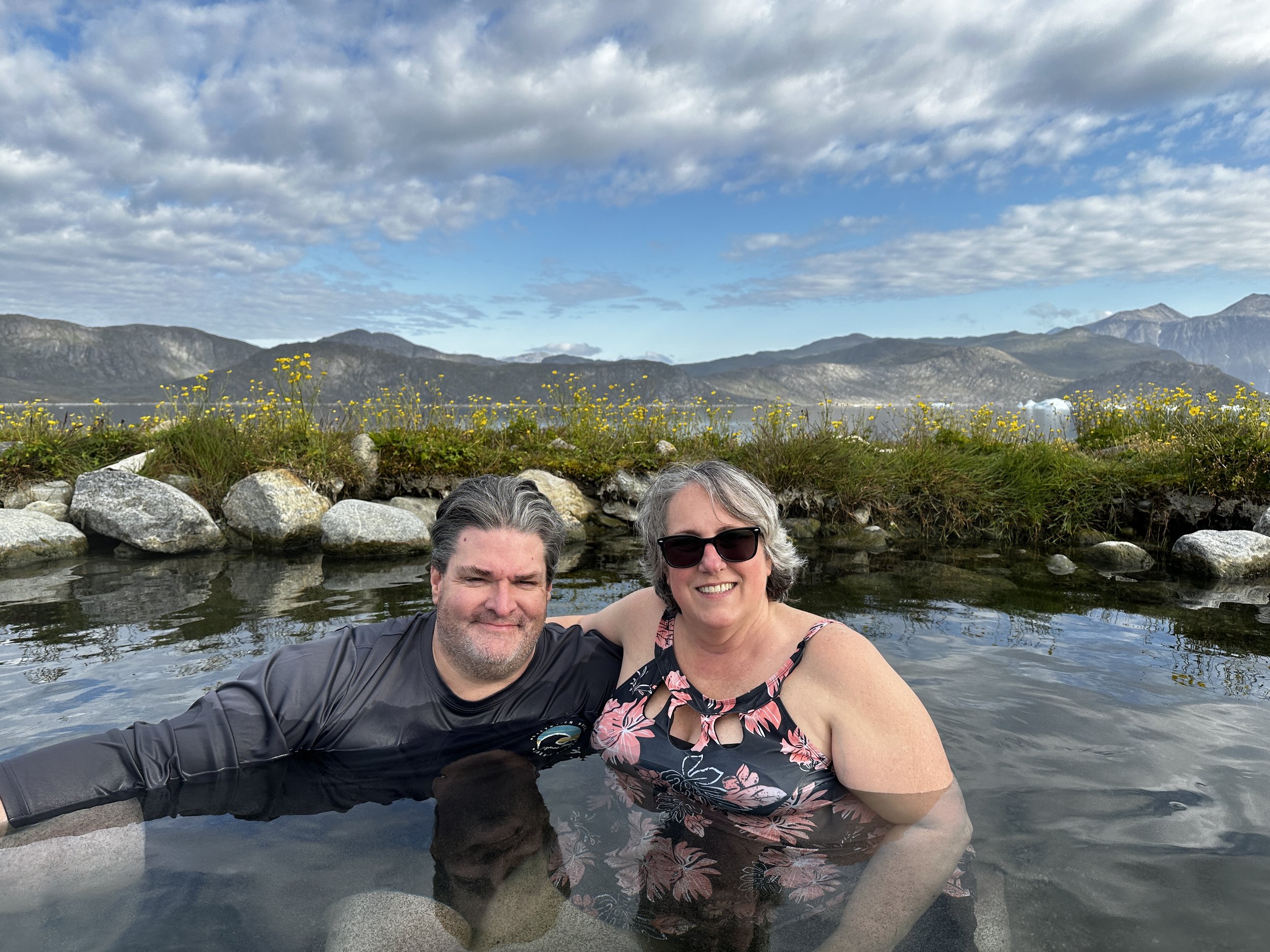
“Who does that? We do.” That’s what we said to each other. It’s our way of validating that following the rules gave us something real.
That is what debt-free travel actually feels like. Not a highlight reel. The ability to say yes to a two-thousand-dollar spontaneous experience, guilt-free, negotiation-free, bill-free, because you planned for the possibility of something like that happening.
We do not have moments in our relationship where we have to say no to something life-changing because we did not plan for it. Or worse, say yes and spend months regretting the payment. That freedom is what we are building toward retirement. And the only way to get there is to build it, one funded trip at a time.
Financial Freedom Is Earned. One Choice at a Time.
Financial Freedom is not something anyone gives you. It is earned, every day, in small decisions. Our freedom came from thousands of small choices and compromises along the way. Things we said no to so we could say yes to what actually matters.
We are not extraordinary people. We lost a house. We paid off a mountain of debt. We made mistakes along the way and kept going anyway. What we have now, the ability to say yes to a hot spring in Greenland without blinking, came from years of doing the boring, unglamorous work of planning ahead.
It’s never a good or bad time to start. It’s just committing to one choice at a time.
If you are reading this and you have not started yet, today is the day. Not because things are perfect. They will not be. Start anyway.
Your Next Step
There are two ways to go deeper on everything in this post:
Watch the full video, Jeff and I walk through the whole story on camera, including the Greenland excursion and the exact conversation we have when we plan a trip.
Download the free Trip Cost Tracker — the same spreadsheet system we use to build out every trip budget, so you can run the numbers on your next trip before you book anything.
▶ Watch the Video: Why We Never Pay Interest on Travel
[LINK: YouTube video — will activate when live]
↓ Download the Free Trip Cost Tracker
LINK: Trip Cost Tracker download
If this is your first time here, welcome. We are Jeff and Bran, and we are building a debt-free travel retirement in real time. Every step, every decision, every number, documented so you can build your own version of it.
Because someday needs a start date.
~ Bran
