How We Actually Pay for Every Trip

July 22, 2026 · 2,534 days to go
We get asked, in one way or another, how we afford everything we do. The honest answer isn't a big secret account or a windfall we're not mentioning. It's a rule, and we don't break it: nothing gets booked until it's already fully funded, or already has a real, working plan to be fully funded before we leave.
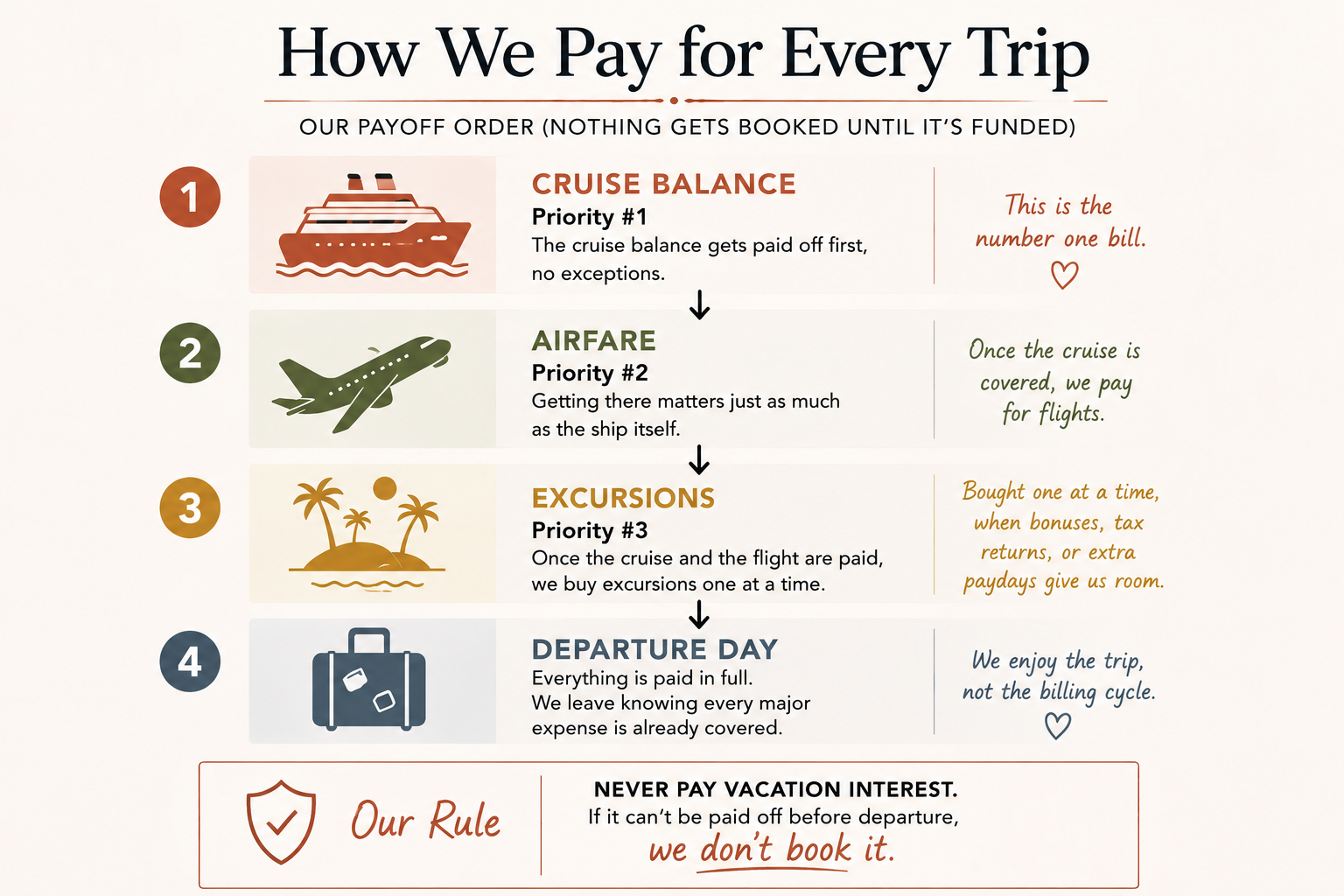
Here's how that actually plays out. Say we put a deposit down on a cruise, often as much as eighteen months out. From that point, we count the paydays between now and departure and work down a strict order. Cruise balance first, no exceptions, that's the number one bill. Then airfare, because getting there matters just as much as the ship itself. Excursions come last, because once the cruise and the flight are covered, we'd still have a great trip even if we skipped every excursion entirely. Excursions get bought one at a time, whenever a bonus, a tax return, or an extra payday gives us room.
Underneath all of it is one non-negotiable rule I hold us both to: nothing goes on a credit card that we can't pay off within thirty to forty five days. Forty five is the real ceiling, thirty is where I'm comfortable. We don't want to pay interest on a vacation, ever. We haven't always been perfect about that rule in past years, but moving into retirement, it stops being a guideline and becomes an absolute, at least in my mind. On a fixed income, even one month of interest on a trip is money we can't afford to lose.
We do keep a travel savings account, but it's not really the main event. It grows quietly in the background and gives us a little room to work with when an opportunity shows up, but I treat it as a last resort, not the plan. The real plan is booking something, then paying it off through regular income before departure, so the savings account stays intact for the actual goal: retirement, not this trip.
That discipline is exactly what let us say yes when opportunity knocked. A wall sized TV on sale for a price too good to pass up, since we knew it would easily outlast us to retirement. A twelve day British Isles cruise, listed for two hundred and fifty dollars a person through a casino discount deal, booked without a second thought, because that kind of price doesn't come around twice. We're frugal, but we're also opportunistic. Watching for real value and moving on it isn't the same as being impulsive, it's part of the plan.

The Paris trip with our granddaughter and my cousin is a good example of how this plays out under pressure. We'd wanted the full version for years, seven to ten days. Rather than keep waiting for the day that version was fully funded, we scaled it down to four days and made it happen instead. Smaller, but real, and paid for.
If you wanted to copy this rule for your own trips, here's where I'd tell you to start. Don't say you want to go somewhere broad, like Africa, and stop there, a safari alone can run anywhere from five thousand to twenty five thousand dollars a person, that's not a plan, that's a wish. Pick your minimum and your maximum. Research inside that range until you land on a few real options. Then figure out what deposits are required, what needs to be paid off and when, and whether your timeline between now and departure is actually realistic against your savings and your regular income. If the math doesn't work, extend the timeline. It's that simple, and that strict. You do not go into debt for a vacation. No exceptions.
